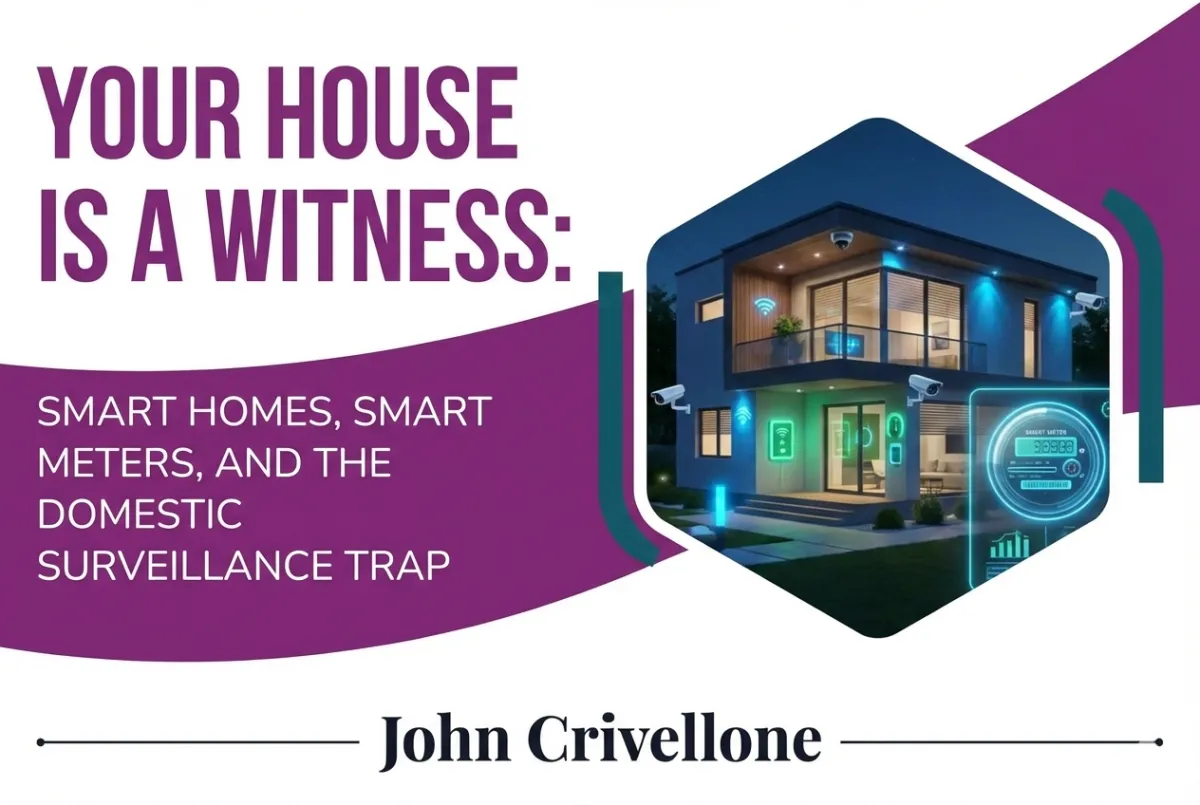
Your House Is a Witness: Smart Homes, Smart Meters, and the Domestic Surveillance Trap By Jack Crivalle
People think privacy ends when they open social media.
Wrong.
Privacy ends when they bring the microphone inside.
A doorbell camera on the porch. A speaker on the counter. A “smart” TV in the living room. A thermostat that “learns” you. A baby monitor that streams to the cloud.
Suddenly the place that used to be private becomes a dashboard.
This installment in our blog series, inspired by Big Brother Is Watching, is about domestic surveillance - the quiet kind. The kind you buy on sale, install yourself, and defend because it feels helpful.
The Great Lie: “If It’s in My Home, It Must Be Under My Control”
Homes used to be boundaries.
Walls. Locks. Curtains. A private life.
Now homes are networks.
And a network is only as private as the companies behind it.
People assume: if I bought it, I control it.
But most connected devices don’t operate under your control. They operate under terms. Under remote updates. Under cloud storage policies that can change without your permission.
You don’t own the system. You rent access to it.
Smart Devices Don’t Just Listen - They Create a Pattern of You
Smart TVs, Cars, and Appliances: The Stuff Nobody Thinks About
Most people focus on phones and speakers. That’s where the marketing screams.
But the quiet stuff matters too.
Smart TVs can track what you watch, when you watch, and how long you stay. Cars can log location, routes, speed, driving habits, even when you brake. Appliances can report usage patterns that reveal routines.
And because it’s “just a TV” or “just a car,” people don’t lock it down like they would a laptop.
That’s the opportunity: the less people suspect it, the more they accept it.
The most dangerous part of domestic surveillance isn’t one recording. It’s the routine.
A single data point is noise. A pattern is identity.
When your devices log time, motion, audio triggers, door opens, temperature changes, and daily habits, they build a profile that’s more honest than your social media.
And the profile doesn’t need your name to be useful. It just needs to be consistent.
That’s why the book calls out everyday systems - your phone, your water meter, your smart home - quietly reporting your life back to corporations and agencies.
Smart Meters: The Boring Bill That Became a Behavioral Report
Let’s talk about the least glamorous surveillance tool ever invented:
Your utility data.
Most people treat utilities like background noise. Just a bill.
But Big Brother Is Watching points out something most people never consider: your water usage can reveal when you’re showering or flushing the toilet.
That’s the point: patterns create visibility.
Spikes, intervals, cycles, timing - they can reveal routines. When you wake up. When you leave. When you return. Whether you’re home alone. Whether something unusual is happening.
Now combine that with location data, phone activity, and connected-device logs. That’s not a bill. That’s a timeline.
Cameras Everywhere: Your Home Doesn’t Just Feel Watched - It Can Be Rewatched
Smart Locks and Doorbells: Convenience That Can Become Control
A smart lock feels like empowerment. No keys. Remote access. Temporary codes.
But it also creates a log: who came in, when they came in, how long they stayed.
Now add a doorbell camera. Now add facial recognition. Now add cloud storage.
You’ve created a timeline of everyone who crosses your threshold.
That can protect you. It can also be used against you - depending on who gets access and what story they want to tell.
Remember: data doesn’t just exist. It gets interpreted.
People buy cameras for safety. That’s the pitch.
But cameras also create a permanent record of your life’s movement.
And the moment that record exists, it becomes searchable, shareable, hackable, and subpoena-able.
The book notes that hundreds of cameras can capture your image every day. Whether it’s on the street or on your own porch, the result is the same: modern life is increasingly legible.
And once life is legible, it becomes manageable.
The Trojan Horse: Security That Creates Vulnerability
The Cloud Is Someone Else’s House - And Your Data Is Living There
A lot of smart devices don’t really work unless you send your home life to the cloud.
Cloud storage sounds abstract. It’s not. It’s just your recordings and logs sitting on servers owned by people you’ve never met, operated by employees you’ll never vet, governed by policies you didn’t negotiate.
And those policies can change overnight.
You didn’t “buy a camera.” You subscribed to an ecosystem. One that can expand permissions, change retention, share data with partners, or respond to legal requests - all without asking you for a second signature.
That’s why “I bought it” doesn’t equal “I control it.”
Here’s the irony no one advertises:
The more connected security you install, the more pathways you create into your home.
Every connected device is a door.
Some doors are locked well. Some are held shut with default passwords and lazy updates. And even when security is solid, privacy can still fail - because the threat isn’t only hackers.
The threat is the business model.
Data sharing policies. Vendor partnerships. Cloud storage. Human access. “Quality review.” Outsourced customer support. One breach away from someone else knowing when your front door opens.
“I’m Not Important” Is How People Volunteer to Be Profiled
Kids, Guests, and Consent: Whose Privacy Is Being Traded?
Here’s the part people ignore:
When you fill a home with surveillance, you’re not only making decisions for yourself.
You’re making decisions for your kids. Your spouse. Your friends. Your guests. The babysitter. The contractor. Anyone who steps inside.
A home used to be the place people spoke freely. Now it’s the place people wonder if they’re being recorded.
If you want a simple standard: don’t record people in private spaces. Don’t put microphones where someone might reasonably expect privacy. And if you do record in common areas, be transparent.
Trust isn’t just a relationship thing anymore. It’s a technology thing.
A lot of people say: “I’m not important enough to be watched.”
That’s not a defense. That’s a misunderstanding of scale.
Modern surveillance isn’t personal. It’s industrial.
You aren’t tracked because you’re special. You’re tracked because you’re predictable - and prediction is profitable.
In a world where privacy is becoming a luxury, domestic surveillance is the easiest sell: you call it comfort, and people install it willingly.
How the Domestic Surveillance Stack Works
Here’s the chain in plain English:
A device collects signals (audio, motion, usage, routine).
Those signals get stored or transmitted (often to the cloud).
They’re matched with identifiers (account ID, device ID, IP address, location).
They’re cross-referenced with other sources (apps, browsing, purchases, contacts).
A profile is built (habits, preferences, risk scoring).
That profile influences outcomes (ads, pricing, offers, access, suspicion).
Now your home isn’t private. It’s a live data feed.
The Real Danger: It Changes What People Say and Do at Home
Five Questions Before You Bring Another “Smart” Device Home
If you want a fast filter before you buy anything connected, ask these five questions:
Can this work locally without internet or a mandatory account?
Can I disable the microphone/camera and still use core functions?
Where is data stored, and can I control retention (or delete it completely)?
What permissions does the app demand (location, contacts, always-on access)?
What happens if the company gets bought, changes policy, or shuts down?
If you can’t answer these, you’re not making a purchase. You’re accepting a black box.
Domestic surveillance doesn’t just record your life. It reshapes it.
People speak differently when they think a device is listening. They argue less openly. They hesitate. They soften opinions. They self-censor.
That’s the win: you don’t need to punish people if you can make them manage themselves.
A home that feels watched stops being a refuge. It becomes a stage.
What You Can Do Without Moving Into the Woods
A Practical Home Privacy Checklist (No Paranoia Required)
Here’s a simple checklist that actually moves the needle:
Turn off voice purchasing and always-listening features you don’t use.
Disable ad personalization and tracking where possible.
Shorten cloud retention (days, not months). Delete old clips.
Rename devices and change default passwords (yes, every time).
Put IoT devices on a separate guest network when possible.
Cover cameras you don’t need active. Power down microphones you don’t need on.
Avoid placing devices in bedrooms or anywhere private conversations happen.
Update firmware on a schedule - stale devices become easy targets.
None of this is dramatic. It’s basic hygiene - like locking a door.
You don’t need to become a hermit to reclaim privacy. But you do need to stop sleepwalking.
Here are real moves normal people can make:
Reduce always-on microphones. If you don’t need a voice assistant, don’t keep one. If you keep one, control power - not just mute.
Be allergic to unnecessary “smart.” If a device needs an account, cloud storage, and permanent permissions to do a basic job, rethink it.
Lock down what you already own. Review permissions. Turn off background access. Change default passwords. Update firmware.
Segment your home network. Don’t put every device on the same digital highway.
Assume every camera feed is a target. Store locally when possible. Limit cloud retention.
Your Mission: Make Your Home a Boundary Again
Walk room to room and identify what collects data. Be honest.
If it listens, logs, or streams, it’s part of the surveillance economy.
Then decide what’s worth it - and what’s just convenience you got used to.
Because the modern home can either be a sanctuary or a witness.
Pick one.
Final Word: The Most Effective Surveillance Sounds Like Help
Domestic surveillance works because it’s friendly.
It comes in sleek packaging. It uses a cheerful voice. It offers reminders, weather, playlists, and “peace of mind.”
But the question isn’t whether it helps you.
The question is what it costs you.
Because when your house becomes a witness, privacy becomes a memory.
And freedom - real freedom - requires a door you can still close.
This is Jack Crivalle. Still watching. Still warning. Still refusing to call a cage “convenience.”
All blogs are inspired by Jack Crivalle’s book, Big Brother Is Watching.
